
Circular Motion Applied Physics Full guide
Circular Motion Applied Physics Full guide
Important concepts, formulas, units, dimensions and exam-focused key points.
Circular motion and dynamics | Applied Physics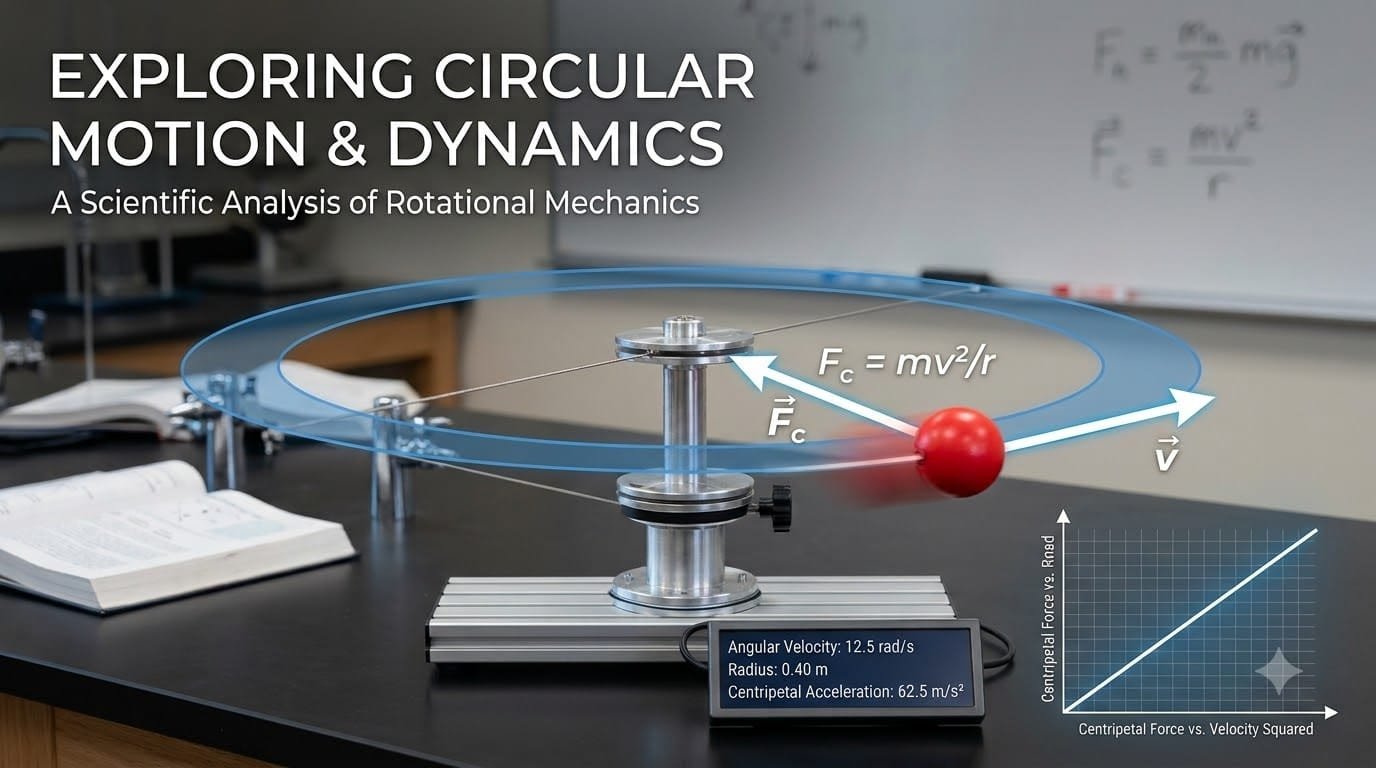
📚 Table of Contents
Circular Motion
Definition:If a particle moves in a plane such that the distance from the fixed point (radius vector) remains constant about the fixed point then its motion is called circular motion.
In kinematics, circular motion is the motion of an object along a circular path.
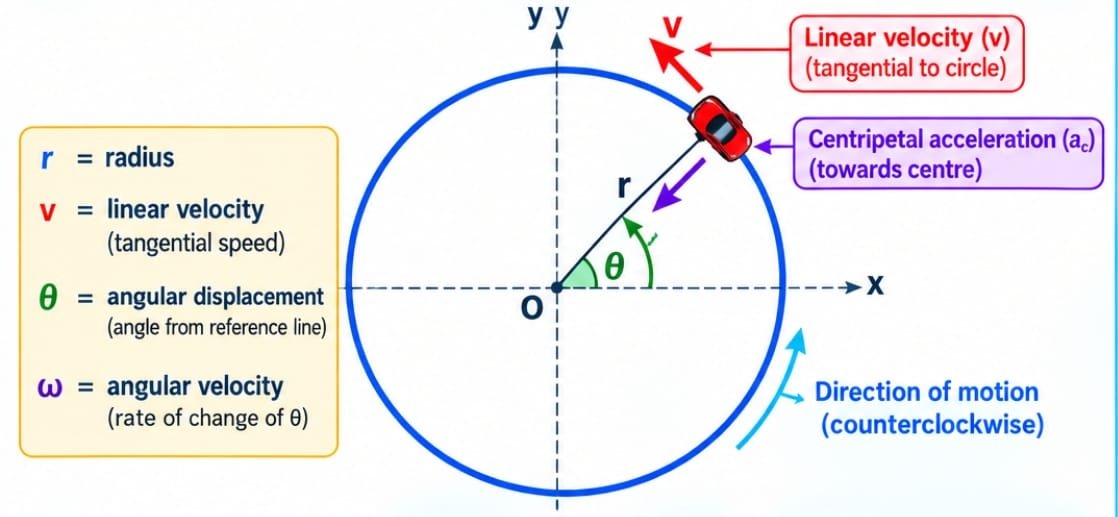
Key Note:In circular motion the speed may remain constant but velocity changes continuously as the direction changes in every instant.
2. Angular Displacement
Definition:The angle through which the radius vector turns as the object moves along the circular path is called angular displacement.
It is the angle at which an object moves on a circular path. It is denoted by θ.
Formula:θ = s/r
where s= arc of length, r= radius
SI Unit:radian (rad)
Dimension: It is a dimensionless quantity.
Nature:Vector quantity
Key Note:Angular displacement tells us how much an object has rotated from its initial1/ angular position to its final poisition .
3. Angular Velocity
Definition:Angular velocity is the rate of change of angular displacement.
It is the vector measure of rotation rate.It is denoted by ω.
The direction of angular velovity in circular motion is akways along the axis of rotation and perpendicular to the plane of motion.
🔥 The right hand rule assigns the direction of the angular velocity vector ( axial vector)
Formula:ω = Δθ/Δt
SI Unit:rad/s
Dimension:[M0L0T-1]
Nature:Vector quantity
Key Note:Angular velocity indicates how fast an object is rotationg and about which axis .
4. Angular Acceleration
Definition:Angular acceleration is the rate of change of angular velocity with respect to time. It describes how quickly an object’s rotational speed is increasing or decreasing.
It is denoted by Greek letter α(alpha).
Formula:
If ω is the angular velocity, the average angular acceleration α over a time interval Δt is:
α = Δω Δt
The instantaneous angular acceleration is the derivative:
α = dω / dt
In terms of angular displacement θ:
α = d²θ dt²
SI Unit:Rad/s2
Dimension:[M0L0T-2]
Key Note:
- Angular acceleration is a vector quantity. Its direction is determined by the right-hand rule and lies along the axis of rotation.
- For constant angular acceleration, the rotational equations of motion are analogous to the equations of linear motion.
- ω = ω₀ + αt
- ω² = ω₀² + 2αθ
Frequency & Time period
Time period :It is the time taken by a particle in uniform circular motion to complete one full revolution or a complete cycle around the circular path.
For a particle in circular motion time taken to complete one revolution is taken as t=T and the angular displacement θ=2π then,
ω = 2π/T
Therefore, T = 2π/ω
Frequency :It is the number of complete revolutions or cycles completed by a particle per unit time.
- Unit: hertz (Hz) = s−1
- Frequency f=1/T
Key Note:Angular velocity (ω) is directly proportional to frequency (f)
Relation between linear and angular velocity
Linear velocity:Linear velocity in circular motion (also know as tangential velocity) is the instantaneous velocity of a particle moving along a circular path. It is always directed along the tangent to the circle at the particle’s current position.
It is the rate of change of displacement with respect to time when the object moves along a straight path.
- Key Note:Linear velocity describes how fast the particle is moving in tangential direction the particle at any instant while following the circular trajectory.
Important Formulas
θ = s/r
ω = θ/t
α = Δω/Δt
ac = v2/r
🧠 Remember
- Angular displacement is measured in radian.
- Angular velocity is the rate of change of angular displacement.
- Angular acceleration is the rate of change of angular velocity.
- Centripetal acceleration acts towards the centre.
- Always check the correct SI unit and dimension in numerical problems.
📝 Practice MCQ
1. What is the SI unit of angular displacement?
A. metre
B. radian
C. radian/second
D. degree/second
✓ Correct Answer: B. radian
Explanation:The SI unit of angular displacement is radian (rad).
Explanation:The SI unit of angular displacement is radian (rad).
2. What is the dimension of angular velocity?
A. [M0L0T-1]
B. [M0L1T-1]
C. [M1L0T-1]
D. [M0L0T1]
✓ Correct Answer: A.
[M0L0T-1]
Explanation:Angular velocity is angular displacement per unit time.
Explanation:Angular velocity is angular displacement per unit time.
3. Centripetal acceleration is directed towards:
A. Outside of the circle
B. Tangential direction
C. Centre of the circle
D. Upward direction
✓ Correct Answer: C. Centre of the circle
Explanation:Centripetal acceleration always acts towards the centre of the circular path.
Explanation:Centripetal acceleration always acts towards the centre of the circular path.
❓ Frequently Asked Questions
Angular displacement is the angle through which an object
rotates about a fixed axis.
The SI unit of angular velocity is radian per second (rad/s).
Centripetal acceleration is the acceleration directed towards
the centre of a circular path.