Table of Contents
Introduction
One of the fundamental questions in fluid mechanics is: What is a fluid, and how does it differ from a solid?
At the molecular level, solids have closely packed molecules with strong intermolecular forces, allowing them to maintain a fixed shape and resist deformation. In contrast, liquids have molecules that are farther apart and can move more freely, making them easy to deform and flow. Gases have even weaker intermolecular forces and greater molecular spacing, enabling them to flow easily and completely fill any container.
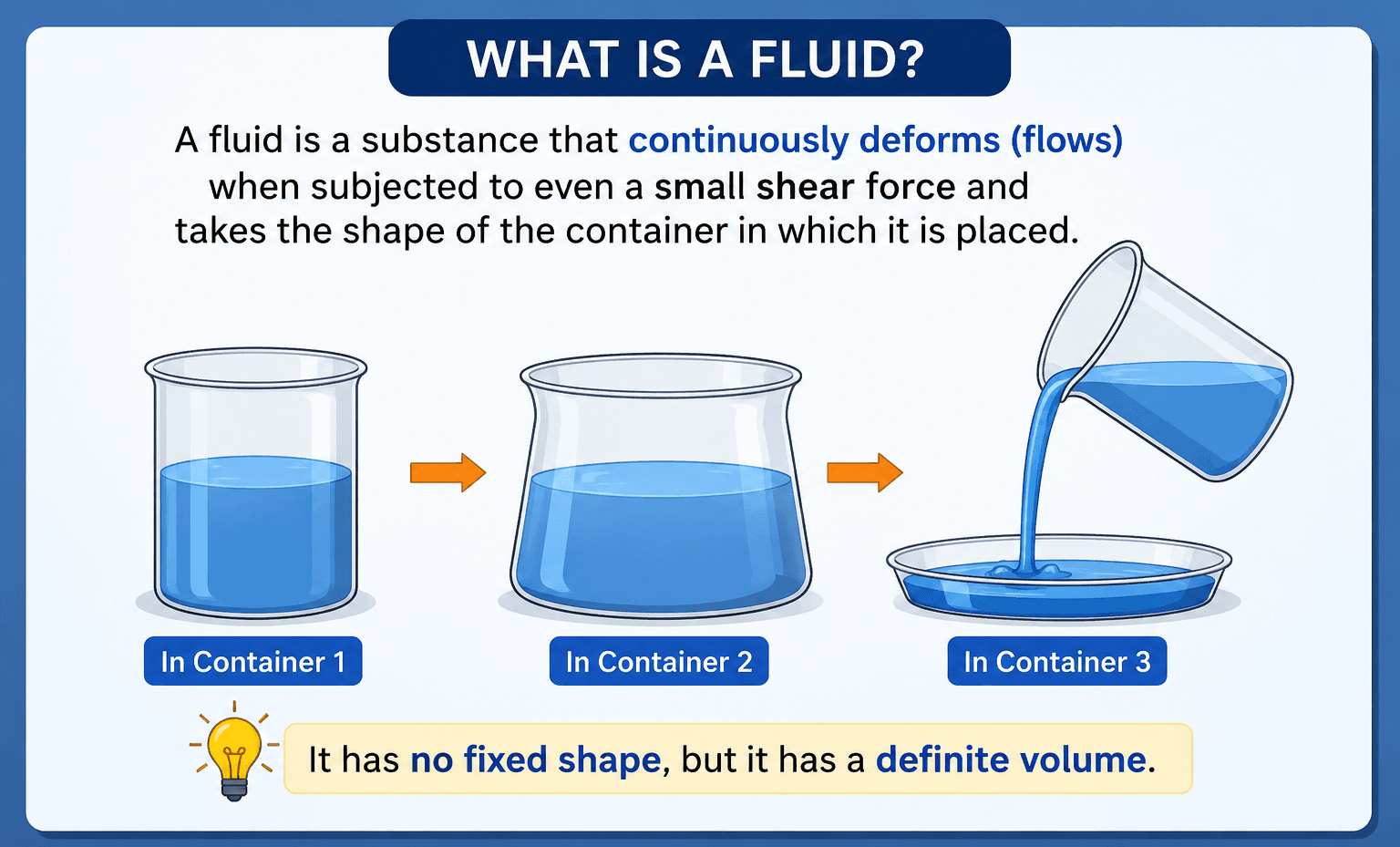
A more precise engineering definition states that a fluid is a substance that continuously deforms (flows) when subjected to any amount of shear stress. Shear stress occurs when a tangential force acts on a surface.
Unlike solids, which may deform slightly and then retain their shape, fluids continue to deform as long as the shear stress is applied. Therefore, liquids and gases are classified as fluids because they flow under shear forces.
Some materials, such as toothpaste, tar, putty, and slurries, exhibit both solid-like and fluid-like behavior. They act as solids under small shear stresses but begin to flow when the applied stress exceeds a certain critical value.
What is a Fluid?
A fluid is a substance that continuously deforms (flows) when subjected to any amount of shear stress. Unlike solids, fluids do not have a fixed shape and take the shape of the container in which they are stored.
Fluids can resist –
- Compressive Force
- tensile force(upto surface tension) But
But can’t resist shear stress.