Fluid Mechanics: Fluid and Its Properties
Introduction
One of the fundamental questions in fluid mechanics is: What is a fluid, and how does it differ from a solid?
At the molecular level, solids have closely packed molecules with strong intermolecular forces, allowing them to maintain a fixed shape and resist deformation. In contrast, liquids have molecules that are farther apart and can move more freely, making them easy to deform and flow. Gases have even weaker intermolecular forces and greater molecular spacing, enabling them to flow easily and completely fill any container.
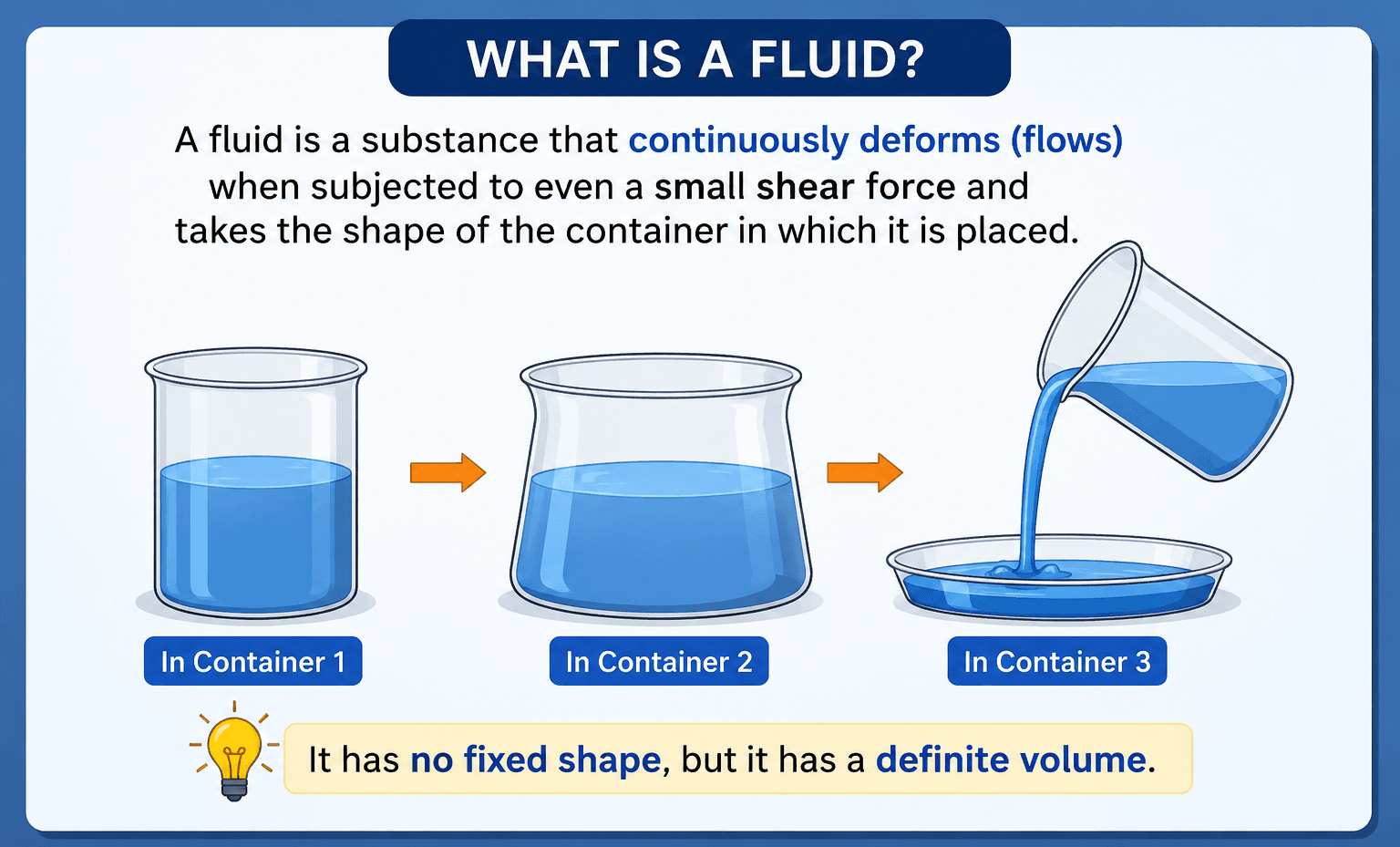
A more precise engineering definition states that a fluid is a substance that continuously deforms (flows) when subjected to any amount of shear stress. Shear stress occurs when a tangential force acts on a surface.
Unlike solids, which may deform slightly and then retain their shape, fluids continue to deform as long as the shear stress is applied. Therefore, liquids and gases are classified as fluids because they flow under shear forces.
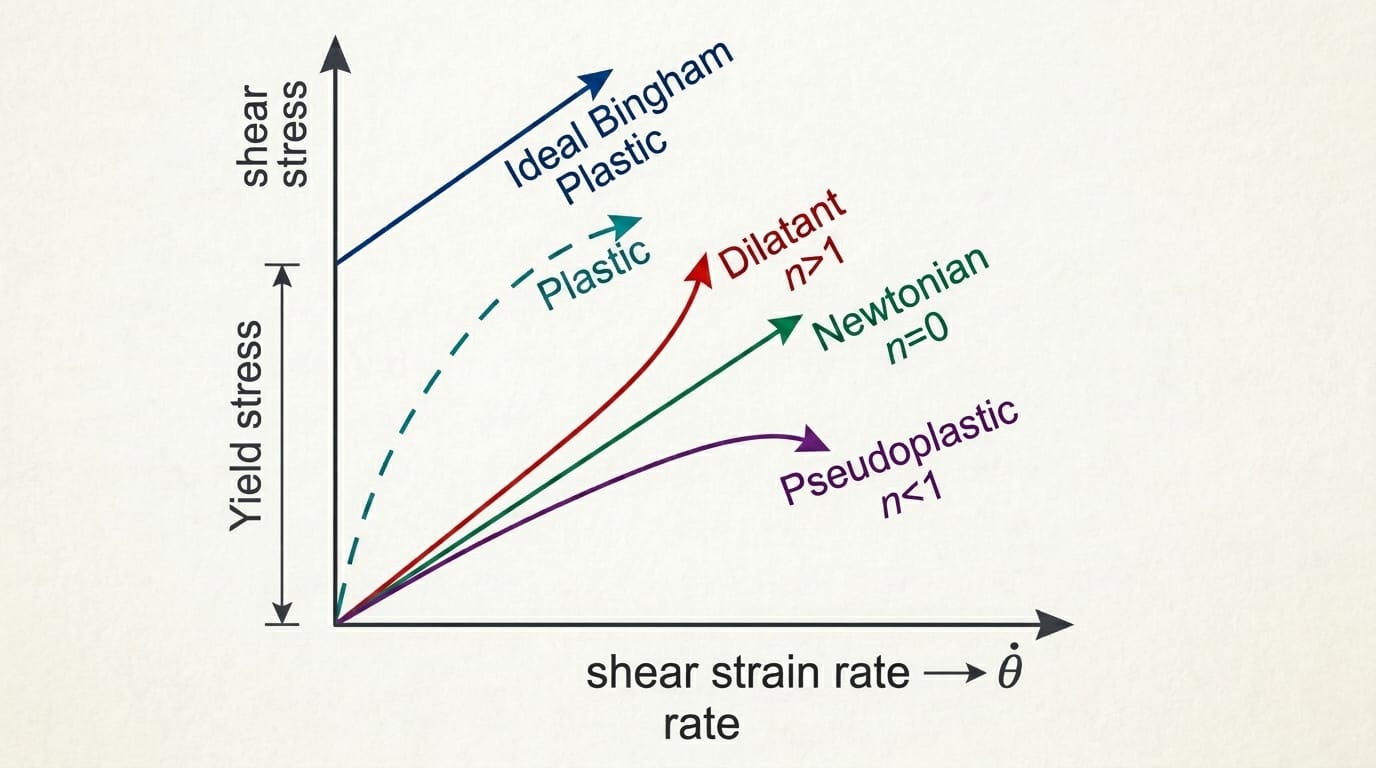
Some materials, such as toothpaste, tar, putty, and slurries, exhibit both solid-like and fluid-like behavior. They act as solids under small shear stresses but begin to flow when the applied stress exceeds a certain critical value.
What is a Fluid?
A fluid is a substance that continuously deforms (flows) when subjected to any amount of shear stress. Unlike solids, fluids do not have a fixed shape and take the shape of the container in which they are stored.
Fluids can resist –
- Compressive Force
- tensile force(upto surface tension) But
But can’t resist shear stress.
Properties of Fluid
Density (ρ)
Density or mass density is the ratio of mass of a fluid to its volume.It is denoted by ρ.
Density is mass per unit volume.
$$ Density (ρ) = \frac{m}{V}$$
Where:
- ρ = Density (kg/m³)
- m = Mass (kg)
- V = Volume (m³)
Density of air at atmospheric pressure at 20C is 1.24Kg/m3
📝 Density decreases with increase in temperature.
📝 Density increases with increase in pressure.
Specific weight
Specific weight or weight density is the ratio of weight of a fluid to its volume. It can be defined as the weight per unit volume. It is denoted by γ.
$$ \text{Specific weight} (γ) = \frac{\text{Weight of the fluid}}{\text{Volume of the fluid}}$$
$$ \text{Specific weight}(γ) = \frac{mg}{V}$$
$$ \text{Specific weight} (γ) = ρg $$
📝 Unit: $$ \text{ It’s unit is N/m}^3 $$
💡 $$ \text{ Specific weight of water is 9.81 KN/m}^3 $$
📝 $$ \text{ It’s dimension is } \ = [M^1 L^{-2} T^{-2}] $$
Specific volume
Specific volume is the volume per unit mass of a fluid. It is the reciprocal of density.
$$ \text{Specific volume} = \frac{volume}{mass}$$
📝 unit: $$\text{Unit of Specific Volume} = \text{m}^3/\text{kg} $$
💡 $$\text{Specific Volume of air } = 0.78 \text{m}^3/\text{kg} $$
Specific gravity
Specific gravity is the ratio of the density of a fluid to the density of water at 4°C. It is denoted by s.
$$ \text{ Specific gravity } = \frac{\text{ density of fluid}}{\text{ density of water at 4°C}}$$
$$ \text{ Specific gravity (s)} = \frac{ρ_(fluid)}{ρ_(water)}$$
$$ \text{ Specific gravity (s)} = \frac{ρ_(fluid) \times g }{ρ_(water) \times g }$$
$$ = \frac{\text{ weight density of fluid}}{\text{ weight density of water at 4°C}}$$
💡 It is a dimension less quantity.
Compressibility
Compressibility is the property of a fluid by virtue of which its volume changes when pressure is applied.
It is a measure of the fluid’s ability to be compressed.
- Compressibility of liquid is measured by bulk modulus of elasticity (K)
- Bulk modulus (K) measures resistance to compression. So K increases means resistance to further compression increases.
💡Therefore compressibility is the reciprocal of bulk modulus of elasticity.
Bulk modulus of elasticity (K) $$ K=-\frac{ΔP}{\frac{ΔV}{V}}$$
💡 Therefore bulk modulus is more means resistance to compression is more,which means compressibility is less.
💡For truly incompressible fluid bulk modulus elatsicity is infinite.
📝For liquid: When temperature is decreased, cohesive force betwen molecules increases,which results in higher resistance to further compression.
So if temperature is decreased, K increases.
For gas: A collision between gas particles increases with the increase of temperature.It results higher internal pressure which increases the resistance to further compression.
So if temperature is increased, K increases.
📝Unit: $$Compressibility (β) =\frac{1}{K} $$
There fore unit of compressibility is m^2/N
Viscosity
Viscosity is the property of a fluid by virtue of which it offers resistance to the relative motion between its adjacent layers.
Viscosity is a measure of a fluid’s internal resistance to flow or deformation under shear stress. It describes how “thick” or “sticky” a fluid is — higher viscosity means the fluid flows more slowly or resists motion more.
Density and specific weight are the properties that measures the “heaviness” of a fluid. But viscosity, is the measures of a fluid’s resistance to flow. Therefore, to accurately understand and analyze fluid behavior, engineers must consider not only density and specific weight but also the fluid’s viscosity and other flow characteristics.
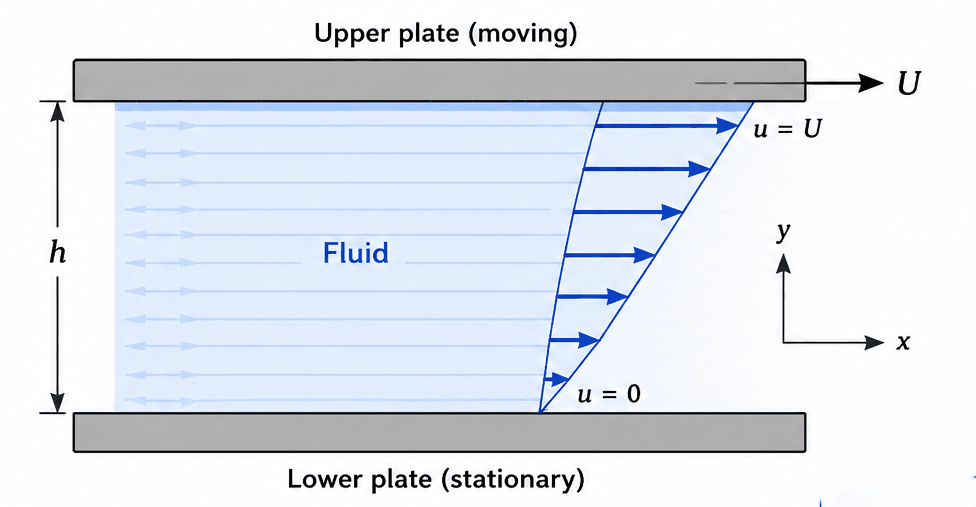
Newton’s law of viscosity: Newton’s law of viscosity states that the shear stress in a fluid is directly proportional to the velocity gradient(rate of shear strain).
The mathematical expression for Newton’s law of viscosity is:
$$\text {shear stress(τ)}= \frac {du}{dy}$$
$$\text {shear stress(τ)}= μ \frac {du}{dy}$$
Where:
- τ is the shear stress in the fluid (in pascals, Pa)
- μ is the dynamic viscosity of the fluid (in pascal-seconds, Pa·s)
- du/dy is the velocity gradient (in inverse seconds, s-1)
Origin of viscosity:
- For liquid viscosity is caused by the intermolecular force of attaction.
- For gases viscosity is caused by the transfer of molecular momentum.
Effects of Temperature on Viscosity:
Liquid: If temperature is increased, viscosity is decreased as the thermal agitation will overcome the intermolecular attraction.
Gas: If temp is increased, viscosity will increase as the increase in temperature cause more molecular momentum transfer.
Dynamic Viscosity (Absolute Viscosity)
Dynamic viscosity is the property of a fluid that measures its resistance to shear stress or flow due to internal friction between adjacent fluid layers.
It is denoted by μ.
Mathematically, $$\text {shear stress(τ)}= μ \frac {du}{dy}$$
Unit:
C.G.S unit of dynamic viscosity is dyne.s/cm² or Poise
S.I unit of dynamic viscosity is N.s/m²
Kinetic Viscosity: Kinematic viscosity is the ratio of dynamic viscosity to the density of the fluid.
Mathematically, $$ \text {kinetic viscosity(γ)}= \frac {μ}{ρ}$$
Unit:
C.G.S unit of kinetic viscosity is cm²/sec or stokes (
S.I unit of kinetic viscosity is m²/sec (1 Stoke=
)
Surface Tension
At the interface between a liquid and a gas, or between two immiscible liquids, forces develop in the liquid surface which cause the surface to behave as a “skin” or “elastic membrane” stretched over the fluid mass. This force per unit length is known as surface tension.
Surface tension is the property of a liquid that causes its free surface to behave like a stretched elastic film, tending to contract and occupy the minimum possible surface area.
- It arises due to the unbalanced cohesive forces acting on the liquid molecules at the fluid surface.
- Surface tension is the tension of the surface which cause the surface to behave as a “skin” or “elastic membrane over the free surface.Though is skin or membrane is not actually present, this hypothetical membrane allows us to explain several real life phenomena like-
1. A steel needle or a razor blade will float on water.
2. Small insects can walk on the surface of water.
Effects of Temperature: If temperature is increased, cohesive force decreases and this will results in decrease in surface tension.
Effects of Additives or impurities:
- Surfactants like Soap and detergents decrease surface tension.
- Nacl increases surface tension.
Real life application:
- Due to surface tension, small liquid droplets tend to form spherical shapes because a sphere has the minimum surface area for a given volume.
- Cleaning with detergents: Soaps and surfactants lower surface tension so water can spread and penetrate dirt/fabrics better.
- Surface tension plays an important role in capillary action
- A small needle or razor blade may float on water.
- The formation of soap bubbles
Types of Fluid
Fluids are classified primarily based on how their viscosity (resistance to flow) behaves under applied shear stress.
Ideal Fluid
An ideal fluid is a hypothetical (imaginary) fluid that has zero viscosity and zero surface tension.
- Ideal fluid in incompressible and non viscous.
- No real fluid is ideal, but this assumption simplifies many analysis in fluid mechanics applications.
Newtonian Fluid
Fluids for which the shearing stress is linearly varies with the rate of shearing strain. It means fluid that obeys Newton’s Law of Viscosity,known as Newtonian fluids.
Examples: Water, air, glycerin, kerosene, mineral oils, alcohol.
Non-Newtonian Fluids
A Non-Newtonian fluid does not obey Newton’s Law of Viscosity.
Characteristics:
- Viscosity changes with the rate of shear strain.
- Non-linear relationship between shear stress (τ) and velocity gradient (du/dy).
Example: Toothpaste, Paint, Blood etc.