
Reciprocating compressor: It’s working principle with parts
Table of Contents
A reciprocating compressor is a positive-displacement machine that compresses gas by using a reciprocating piston inside a cylinder. It works on the principle of increase of pressure by reducing the volume of a gas-filled.
Basic Components:
Cylinder: The chamber where compression occurs.
Piston: Moves (B.D.C to T.D.C) to change the volume.
Crankshaft and Connecting Rod: Convert rotary motion into the piston’s reciprocating motion.
Suction (Inlet) Valve: Allows low-pressure gas to enter.
Discharge (Outlet) Valve: Releases high-pressure gas.

Step by step working:
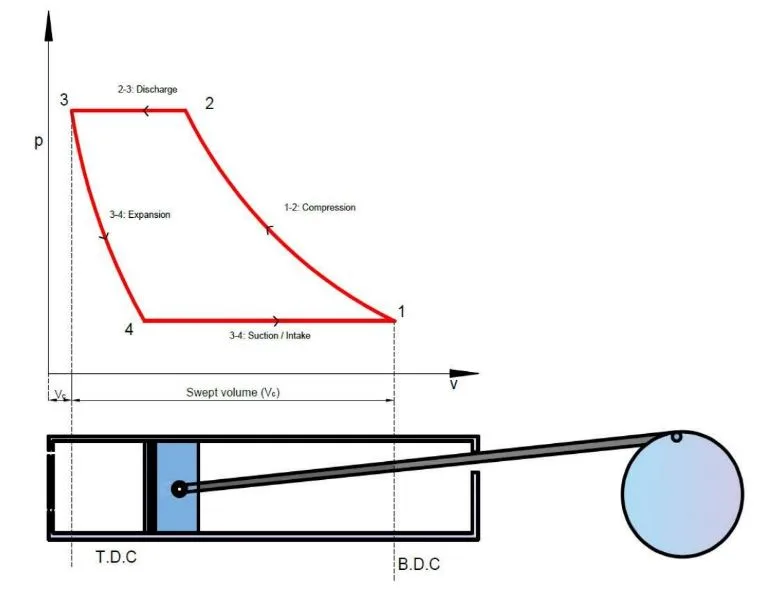
The operation follows a four-stage cycle for each crankshaft revolution, corresponding to the two piston strokes (forward and return). This cycle is commonly represented on a P–V (pressure–volume) diagram.
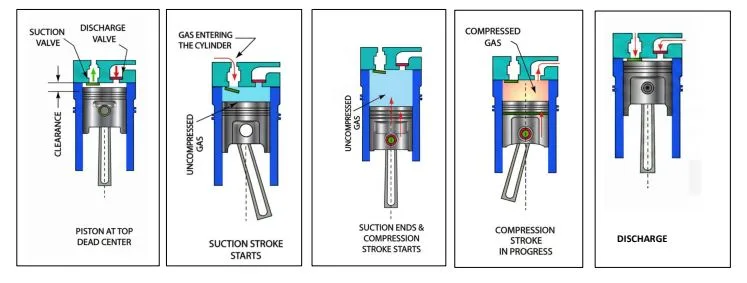
Suction (Intake) Stroke: As the piston moves from top dead center to bottom dead center, it creates a vacuum inside the cylinder. The suction valve opens, allowing low-pressure air to enter at nearly constant pressure, while the discharge valve stays closed.
Compression Stroke: When the piston moves back toward top dead center, both valves remain closed. The gas is compressed as its volume decreases, causing an increase in pressure and temperature, following gas laws (ideally isothermal, but in practice closer to polytropic compression).
Discharge Stroke:
Once the pressure inside the cylinder becomes higher than the discharge line pressure, the discharge valve opens. The compressed gas is then forced out into the receiver or system at approximately constant pressure.
Expansion of Clearance Gas: A small portion of gas remains in the clearance space after discharge. As the piston moves downward again, this trapped gas expands until its pressure drops to the suction level, at which point the suction valve opens and the next cycle begins.
The cycle repeats continuously. In single-acting compressors, compression occurs only on one side of the piston; in double-acting, it happens on both sides.
For isothermal compression,
\[
\text{Work input per cycle} = p_1 v_1 \ln\left(\frac{p_2}{p_1}\right)
\]
For reversible polytropic compression,
\[
\text{Work input per cycle} =
\frac{n}{n-1} \, p_1 v_1
\left[
\left(
\frac{p_2}{p_1}
\right)^{\frac{n-1}{n}}
– 1
\right]
\]
\[
=
\frac{n}{n-1} \, m R T_1
\left[
\left(
\frac{p_2}{p_1}
\right)^{\frac{n-1}{n}}
– 1
\right]
\]